


Singapore in the Rain: How the City Changes When the Weather Softens Its Edges
August 4, 2026 |J.C. Yue
The first drops always come without warning here.
One minute the sky is the flat white of noon, the light bouncing hard off the glass towers. The next, the air thickens, the wind turns, and the whole city seems to hold its breath. Then it opens.
I grew up with this rhythm. Singapore rain isn't weather you check on an app so much as weather you feel arrive in your bones. After a decade of accompanying my employer across more than forty destinations, I've learned to read skies everywhere — but this one I read without thinking. It's the sky I came from.
And here's the thing most visitors never learn: the city I love most isn't the bright, humid, postcard Singapore. It's the softer one that appears the moment it rains.
How Rain Changes the Feeling of the City
There's a particular quiet that settles over the island when the downpour begins in earnest.
The traffic slows. The pace of people on Orchard Road drops from purposeful to patient. Everyone finds an awning, a covered walkway, a doorway — and for a few minutes, the relentless forward motion of the place just stops.
A rainy day in Singapore is the closest this city ever comes to standing still.
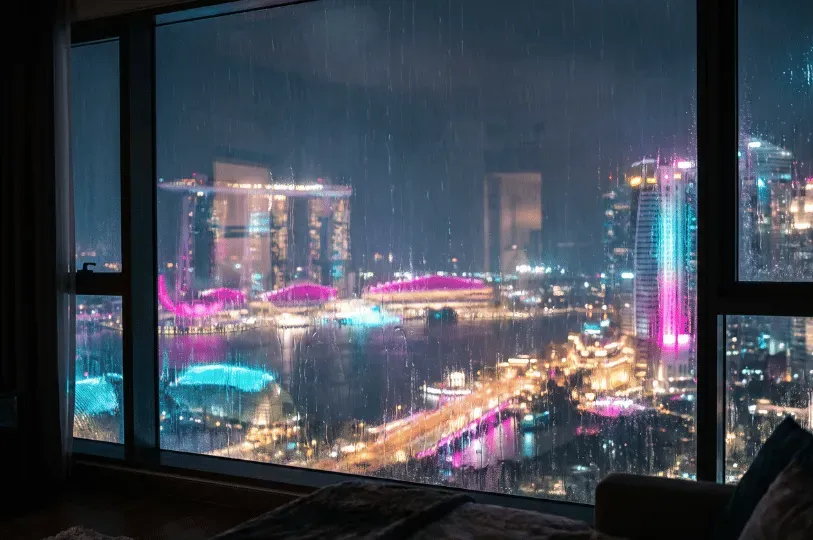
I've watched executives who normally answer every email within the minute simply stand at a hotel window, coffee cooling in hand, doing nothing but watching water run down the glass. Rain gives permission to pause. In a city built on efficiency, that permission is rare and quietly precious.
The Sound Before the Sight
You hear it before you see it.
A low hiss builds across the rooftops, then the drumming on the covered walkways, then the deeper note of water hitting the canals. The
tropical rainforest climate means these storms arrive with real force — brief, heavy, complete. Twenty minutes of tropical fury, then a washed-clean stillness.
Rainy Day Singapore: The Neighborhoods That Come Alive

The Singapore hidden side shows itself best in the rain. The tourist checklist dissolves, and the older, quieter city returns.
Tiong Bahru Under Grey Skies
I always send guests to Tiong Bahru when the forecast turns.
The low pre-war flats, the curved balconies, the smell of wet concrete and old kopi — the neighborhood was made for slow, damp mornings. Rain empties out the weekend crowds and leaves the place to the residents and the few of us who know to come.
You duck into a bookstore. You wait it out over toast and soft eggs. You are, for once, not rushing anywhere.
Chinatown and the Shophouse Shelter
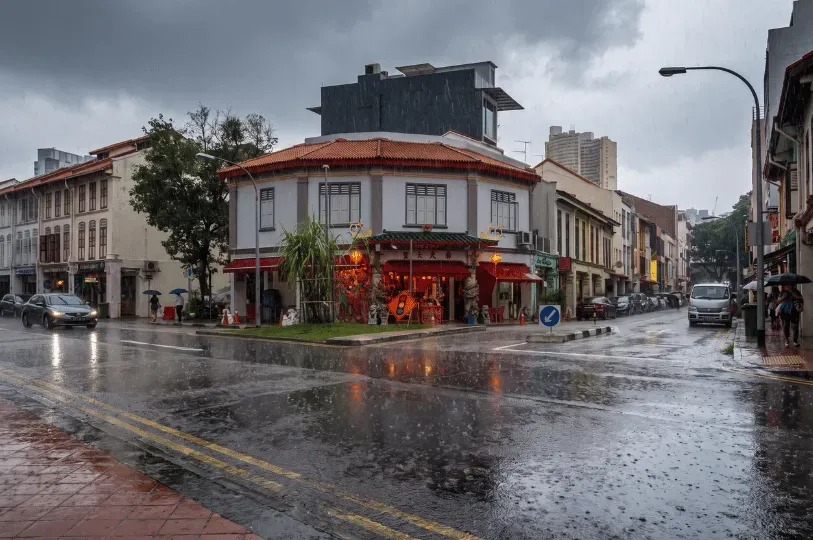
The old shophouses along the five-foot ways were built for exactly this.
Their covered corridors have sheltered generations from the same downpours. When the rain comes to Chinatown, you walk beneath them the way people have for a century — dry, unhurried, watching the water sheet off the tiled roofs.
The architecture here understood the weather long before air-conditioning did.
Singapore Weather Travel: What the Locals Actually Do

Here's the honest insider truth about Singapore weather travel: no local plans a day around avoiding rain. We plan around absorbing it.
Don't Fight the Monsoon — Read It
Singapore has two monsoon windows, and knowing them changes everything.
The Northeast Monsoon, roughly December to March, brings the heaviest, most sustained rain. The Southwest Monsoon, around June to September, delivers the sudden afternoon storms. You can track the patterns through the National Environment Agency rather than a generic weather app — it's what I check before finalizing any itinerary at home.
Pro tip: the rain rarely lasts. Build your day with indoor anchors and let the wet stretches happen in between. Fighting the sky here is a losing game.
The Umbrella Nobody Uses Correctly
Visitors buy the big golf umbrella. Locals carry the small folding one, or nothing at all.
We know the covered walkways connect half the city. We know the MRT stations link underground for kilometers. You can cross much of central Singapore in a downpour and barely feel a drop — if you know the routes. That knowledge is its own quiet luxury.
Singapore Luxury Travel When the Rain Sets In

Rain is where Singapore luxury travel quietly proves itself. The finest experiences here don't depend on sunshine at all.
The Hotel Lobby as Refuge
Some of my favorite moments arranging stays happen on the wet days.
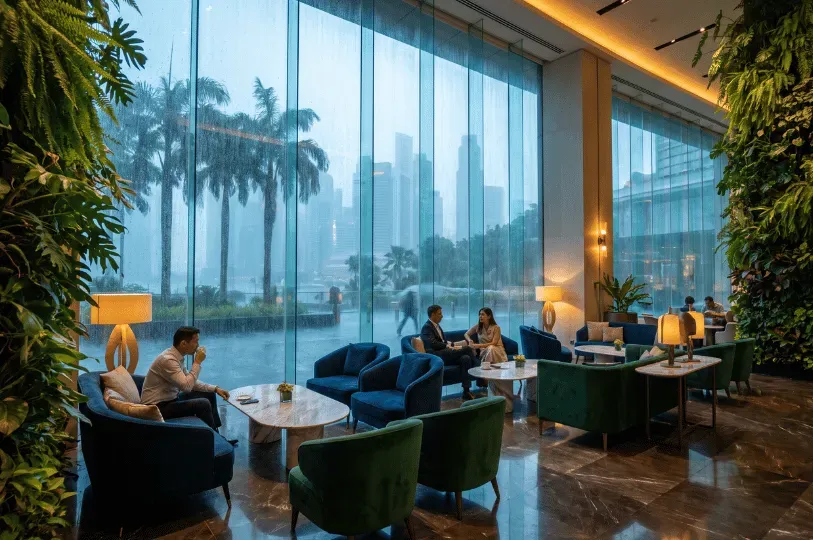
A great Singapore hotel lobby during a storm becomes something more than a thoroughfare. Afternoon tea at a grand old property, the rain hammering the windows, the room warm and low-lit — there is nothing the weather can do to spoil it. If anything, the storm improves it.
I've watched a tense, jet-lagged employer soften completely over a pot of tea while the sky came down outside. The rain did what no spa treatment could.
Indoor Sanctuaries Worth the Weather
When the rain settles in for the afternoon, the city offers refuges built for exactly this.
The National Gallery Singapore, housed in the former Supreme Court and City Hall, is my first recommendation. Its cool marble halls and Southeast Asian collection reward a slow, unhurried visit — the kind rain forces on you. The Gardens by the Bay conservatories are another: you stand inside a cooled glass dome watching the storm break over the Marina Bay skyline.
Hawker Culture in the Rain
This is the part I miss most when I'm abroad.
There is nothing — nothing — like a hawker centre in the rain. The heat breaks. The air fills with steam and the smell of wok fire and simmering broth. The clatter softens under the sound of water on the roof.
A Bowl of Something Hot, and Nowhere to Be
I remember a Tuesday afternoon, caught in a downpour near a neighborhood centre.
I ducked in for cover, not hunger. But the auntie at the noodle stall pushed a bowl of laksa across the counter before I'd fully decided. Coconut broth, thick and warm, a plastic spoon, a cracked stool. The rain outside. My phone, for once, face-down.
Some meals you photograph. That one, I just ate.
The Michelin Guide Singapore has awarded stars to hawker stalls, and rightly so — but the recognition was never the point. The point was always the bowl, the weather, and the quiet company of strangers waiting out the same storm.
The Kopitiam Ritual
Old-school kopitiam coffee tastes better in the rain. I don't need to prove that. I just know it.
Thick, dark kopi. A kaya toast set. The condensation on the glass matching the condensation on the windows. It's a small ceremony, repeated across the island every time the sky opens, and it has held steady while everything else in Singapore changed.
The Emotional Shift a City Undergoes

I've thought a lot about why this city feels so different in the rain.
Singapore is a place that works hard at being impressive — the skyline, the efficiency, the polish. It rarely lets you see it at rest. But rain strips some of that away.
The rain is the one thing here that money and planning cannot control.
And there's something honest in that. For a few minutes, the most orchestrated city in Asia simply surrenders to the weather, like everyone else. The perfect surface fogs over. What's left underneath is gentler, older, more human. That's the Singapore I recognize as home.
Why I Come Back to the Wet Days
After enough beautiful hotel rooms in enough dry, sunny cities, I stopped chasing perfect weather.
The days that stay with me are the grey ones. The storm I waited out in a shophouse doorway. The laksa I didn't plan to eat. The tea that outlasted the downpour. These are the moments the brochures skip — and the ones I'd trade a hundred cloudless afternoons to keep.
Planning Around the Rain: An Insider's Approach

For those coming to see the Singapore hidden side, here's how I'd actually plan it.
Build Flexible, Not Fixed
Don't schedule a day of pure outdoor sightseeing and pray.
Pair one outdoor plan with one indoor anchor, and let the rain decide the order. The Visit Singapore resources are useful for mapping covered and indoor options close together.
Embrace the Off-Hours
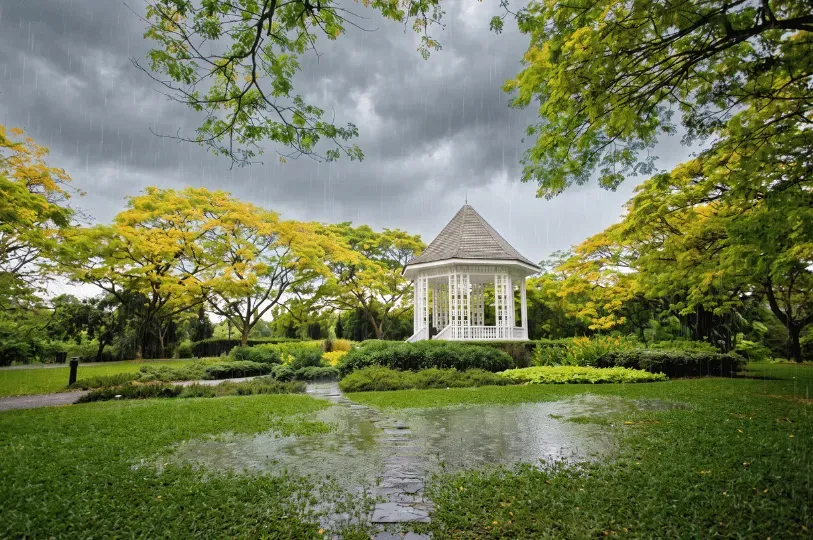
The storms clear crowds. A rain-soaked morning at Singapore Botanic Gardens, a UNESCO site, is a different, quieter, greener experience than a sunny weekend. Bring a light jacket, accept the drizzle, and you'll have the paths almost to yourself.
What the Rain Taught Me About Home
I've stood under skies on four continents. But I never read one the way I read this one.
The rain doesn't ruin Singapore. It reveals it. It slows the city just enough to let you feel what's underneath the shine — the old neighborhoods, the warm bowls, the quiet tables, the strangers sharing an awning.
A rainy day in Singapore isn't a day lost. It's the city, for once, letting its guard down.
Come during the wet season. Let a storm catch you somewhere with a roof and a bowl of something hot. You'll see a version of this place most visitors fly home without ever meeting.
For a deeper walk through my hometown from a local-turned-global perspective, read
The Assistant's Singapore: Navigating My Hometown Through a Local-Turned-Global Lens.











