

The Unwritten Etiquette of Sharing a Chef's Table With Strangers
August 4, 2026 |J.C. Yue

The first time I sat at a chef's table beside people I'd never met, nobody spoke for the first twenty minutes.
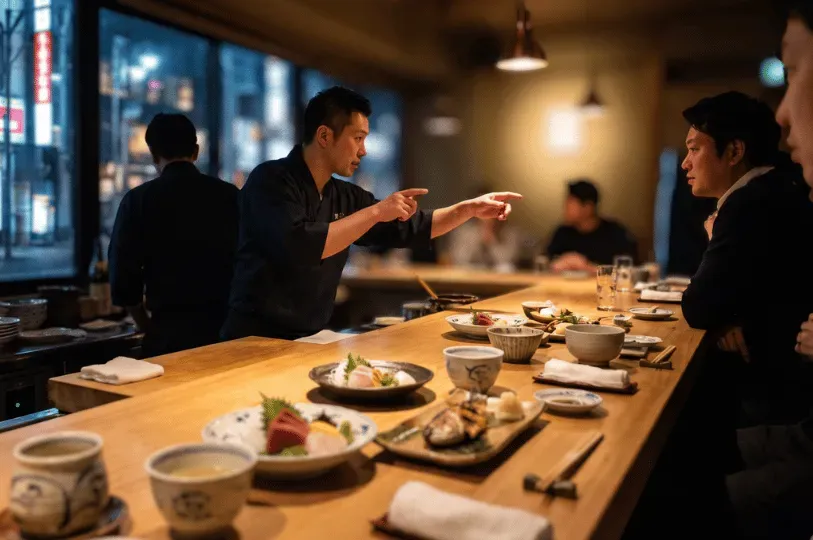
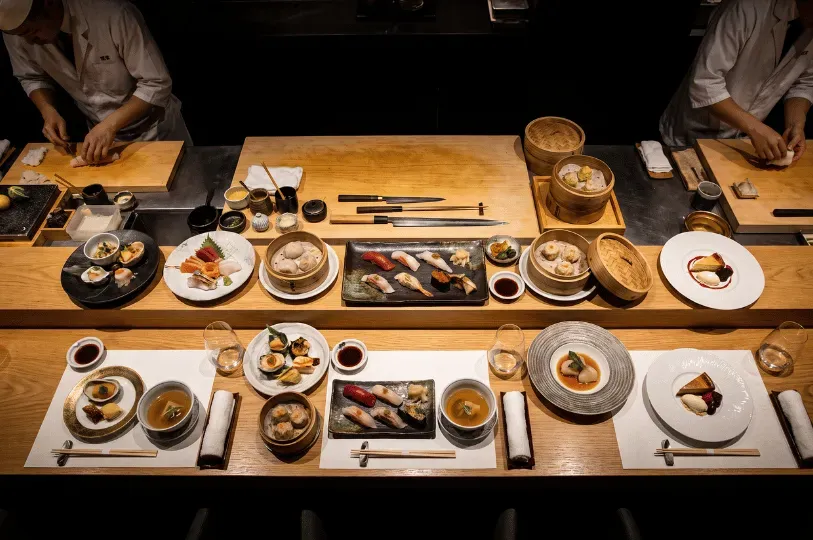
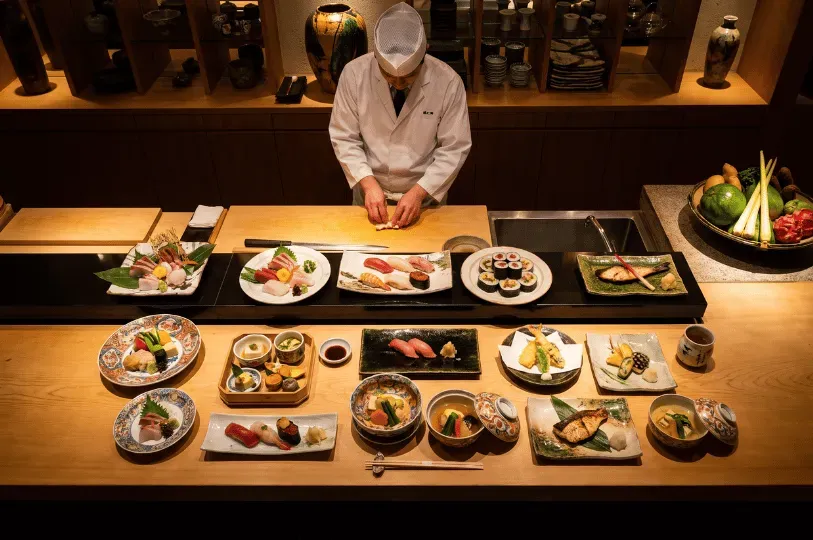
It was Tokyo. Eight seats. A counter of pale hinoki wood worn smooth by years of hands. The chef moved with the quiet economy of someone who had done this ten thousand times. And the seven strangers around me — a couple from Hong Kong, a lone businessman, a pair of regulars — sat in a silence that felt less like awkwardness and more like respect.
I've arranged and attended hundreds of these meals over a decade of accompanying my employer across more than forty destinations. And I've learned that chef's table etiquette is rarely printed anywhere. It's felt. It's read from the room. And the guests who get it wrong are usually the ones who assumed a shared counter was just a table with a better view.
This is what I've observed from the quiet end of the counter — the things nobody tells you before you sit down.
What a Chef's Table Actually Is

Before the etiquette, the definition. Because most people misunderstand what they've booked.
Chef's table dining is not a private room. It's not a normal reservation with a fancier chair. It's a seat inside the working heart of the kitchen — or at a counter where the chef's table becomes both stage and workbench.
A Shared Space, Not a Solo One
The word people forget is shared. Unless you've booked the entire counter — which happens, and which I've arranged more than once — you are sitting shoulder to shoulder with strangers.
That single fact changes everything. Your meal is no longer only yours. It belongs, quietly, to the room.
Why the Format Demands More of You
A regular table lets you disappear into your own conversation. A shared dining experience does not. You're part of a small, temporary company of people who chose the same evening, the same chef, the same trust.
How you behave shapes the meal for seven other people. That responsibility is the whole unwritten code.
The First Rule: Read the Room Before You Speak
Every chef's table has a temperature. Your first job is to take it.
Silence Is Not Coldness
In Tokyo, silence at the counter is reverence. The meal is the conversation. Speak too loudly, too soon, and you break something the whole room came for.
I've watched a well-meaning visitor try to fill that quiet with chatter, and I've watched the chef's shoulders tense almost imperceptibly. He didn't say a word. He didn't need to.
Let the Chef Set the Pace
The kitchen leads. Always.
If the chef offers a story about the fish, you've been invited to talk. If he works in focused quiet, you follow that quiet.
Reading this rhythm is the core of good fine dining etiquette — and it's a skill, not an instinct.
Talking to Strangers Without Ruining the Meal

Here's the tension at the heart of the shared counter: you're seated with strangers, but you're not obligated to befriend them.
The Art of the Light Exchange
A nod. A quiet comment about a dish you both loved. That's usually enough.
The best counters I've attended had a gentle, low current of conversation between courses — never forced, never performed. People shared where they'd travelled from, what brought them in, then returned to their food.
Common mistake: treating the counter like a networking event. Nobody came to hear a pitch between the sashimi and the wagyu.
When to Engage, When to Retreat
If your neighbor turns inward, let them. Some people book a chef's table precisely to be alone in company.
I've sat beside diners who wanted total silence and beside ones who wanted to talk through every course. The etiquette is the same in both cases: match their energy, don't impose yours.
Respecting the Chef's Craft
The person cooking a foot away from you has spent decades earning that spot. Treat the counter accordingly.
Trust the Menu You Were Given
Most chef's tables run on omakase or a set tasting — the omakase tradition of surrendering choice to the chef. You sat down to be led. So let yourself be led.
Asking for substitutions on a fixed tasting isn't confidence. It's a quiet insult to the person who designed the sequence. Real dietary needs are different — flag those long before you arrive, never at the counter.
Photography Without the Circus
Yes, the food is beautiful. A quiet photo is fine at most counters.
But the guest who stands, angles a ring light, and holds up the next course for four minutes has forgotten the seven people waiting. The Michelin Guide counters I've attended treat food that arrives warm and eaten warm as the point — not the archive.
Eat it while it's meant to be eaten. The photograph will survive. The dish, at its peak, will not.
Cultural Differences at the Counter

What's polite in one city reads as rude in another. This is where most travelers stumble.
Tokyo: Reverence and Restraint
In Japan, the counter is close to sacred. You arrive on time — early, even. You thank the chef directly. You don't drown the food in soy or overpower it with talk.
The principle of omotenashi runs both ways here. The chef gives you his complete attention. You return it.
Singapore: Warmth With Boundaries
Back home, our best counters carry a gentler, warmer energy. There's more room for a laugh, a shared observation, a word with the chef.
But the respect holds. In Singapore, I've seen strangers at a counter become easy company by the last course — without anyone ever raising their voice or overstaying the moment. It's warmth with an instinct for boundaries.
London: Conversation as Currency
In London, the chef's table often runs livelier. Conversation is more expected, the exchange between guests part of the experience.
Even there, the understatement of the British table applies. You don't dominate. You contribute, then you listen. Loudness reads as insecurity, not confidence.
The Practical Etiquette Nobody Tells You

Beyond the cultural reading, there are small, concrete habits that mark a good guest. I've watched these separate the welcome diners from the ones the staff quietly dread.
Arrive On Time — The Whole Counter Waits
A chef's table often serves everyone in sync. Your lateness doesn't just affect you.
Seven strangers hold their first course because you couldn't leave twenty minutes earlier. Nothing sours a counter faster.
Pace Yourself With the Room
Eat at roughly the room's pace. Race too far ahead and the kitchen's careful sequence falls out of step. Lag too far behind and everyone waits on you.
Quick win: watch the chef, not your neighbor. The kitchen's rhythm is the true clock.
Handle Wine and Volume With Care
A chef's table is intimate. Voices carry. Wine loosens them.
I've seen a single over-served guest change the temperature of an entire counter. Enjoy the pairings — a good wine pairing is part of the design — but read your own volume as carefully as you'd read the room's.
Thank the People You Can See
At a normal restaurant, the work is hidden. At a chef's table, it's right in front of you.
You watch the hands, the focus, the years of practice.
Acknowledge it. A sincere word to the chef at the end means more here than anywhere else, because you actually witnessed the labor.
What I've Learned From the Quiet End of the Counter

After enough of these evenings, I stopped noticing the theatrics and started noticing the guests.
The Best Diners Make Themselves Small
The finest guests I've sat beside had a particular quality: they took up exactly the right amount of space. Present, warm, curious — never the center.
They understood something simple. The counter isn't a performance you give. It's one you receive, in the company of strangers who chose the same quiet trust.
The Meal Is a Shared Trust
That first Tokyo counter taught me this. Eight people who'd never met, held for two hours in the same small pool of attention. No one performed. No one intruded. And somewhere around the fifth course, the silence stopped feeling like distance and started feeling like company.
That's the reward on offer. Not just the food — though the food was extraordinary — but the rare experience of sharing something delicate with strangers, and getting it right together.
Sitting Down the Right Way
A chef's table asks more of you than a normal reservation. It asks for awareness, restraint, and a willingness to let the room and the kitchen lead.
Get it right and you're rewarded with one of the most intimate forms of the luxury dining experience there is — a seat inside the craft, shared with people who value it as much as you do.
So before your next counter: arrive early, read the room, trust the chef, and take up only the space you need. The strangers beside you are doing the same. Together, quietly, you make the evening what it is.
For a closer look at how these counters turn a meal into something you watch as much as taste, read
Experiential Fine Dining as Theater.











